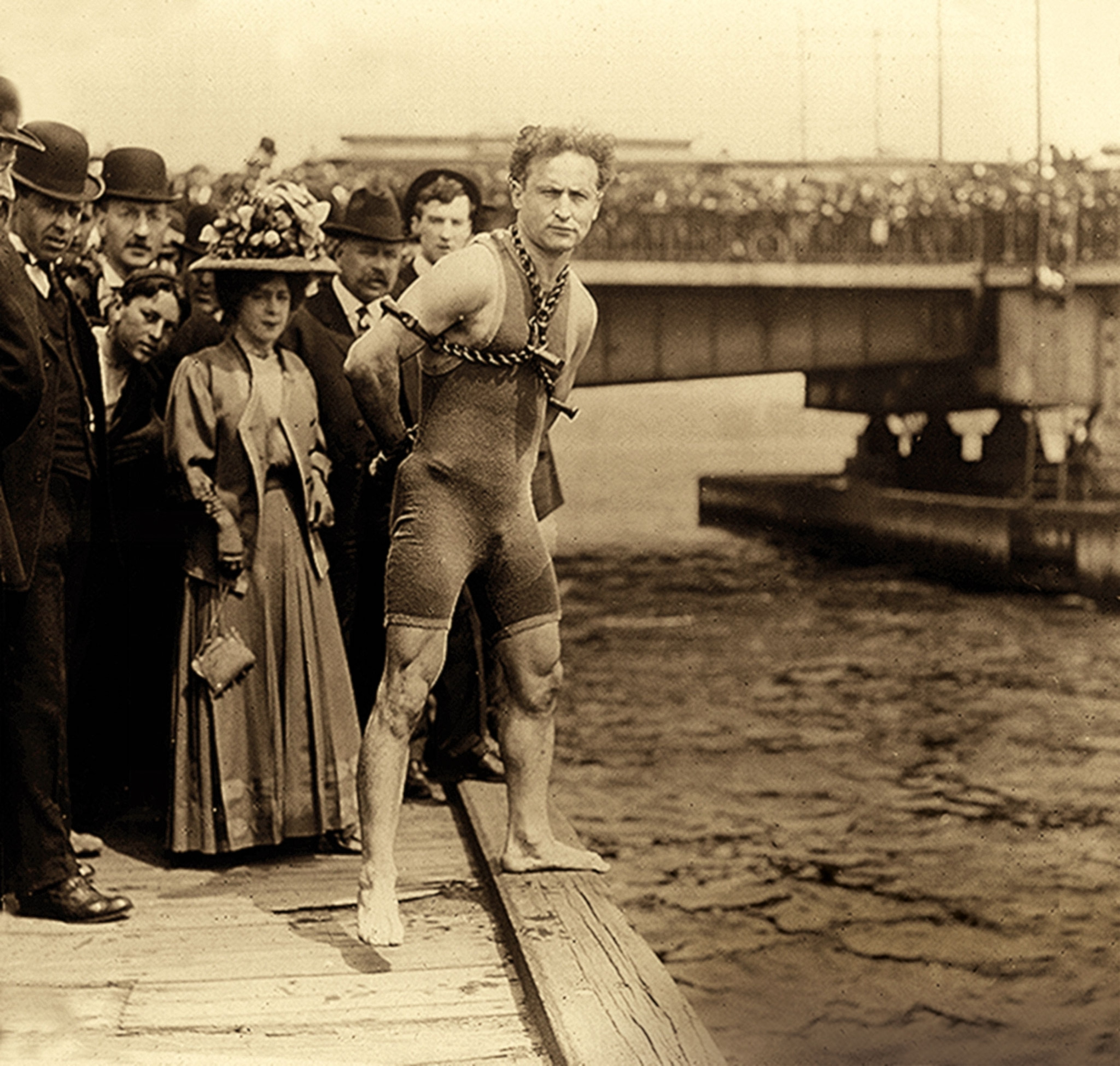
Harry Houdini remains history’s most celebrated illusionist and stunt performer, transforming escape artistry from a novelty act into a global cultural phenomenon through meticulous physical conditioning, relentless self-promotion, and a profound understanding of human psychology. Born Erik Weisz in Budapest, Hungary, in 1874, the man who would become Houdini emigrated to the United States as a young child, eventually adopting his stage name as a tribute to the pioneering French magician Jean-Eugène Robert-Houdin. While his legendary escapes from handcuffs, straitjackets, and locked underwater crates cemented his status as a master showman, his later crusade against fraudulent spiritualists and his pioneering role in aviation reveal a complex figure whose ambitions stretched far beyond the vaudeville stage.
Early Life, Origins, and the Birth of an Illusionist
The foundational years of Harry Houdini were marked by poverty, displacement, and an unyielding drive for self-reinvention. Born to a Jewish family that immigrated to Appleton, Wisconsin, and later settled in New York City, Erik Weisz grew up facing economic hardship. He worked various odd jobs as a youth, including as a tie cutter and a photographer's assistant, while developing a deep fascination with physical dexterity and circus arts. Inspired by traveling circuses and dime museums, young Erik began performing as a trapeze artist and contortionist before gravitating toward card manipulation and traditional magic.
Adopting the stage name Houdini during his early twenties, he performed alongside his brother Theo (later known as Dash) as "The Houdini Brothers" before marrying Wilhelmina Beatrice "Bess" Rahner in 1894. Bess replaced Dash as his onstage assistant, marking the beginning of a lifelong personal and professional partnership that sustained him through years of obscurity. For much of the 1890s, Houdini struggled on small-time circuits, performing coin tricks and traditional magic that yielded modest financial returns and little public acclaim.
The turning point in Houdini's career arrived when he abandoned standard parlor magic to specialize in escapes—a niche that leveraged his exceptional agility, breath-control training, and innate theatrical timing. His breakthrough came in 1899 when he met Martin Beck, a prominent vaudeville manager who recognized the unique commercial potential of escape acts. Beck advised Houdini to drop conventional magic entirely and focus exclusively on escapes, setting him on a path toward international superstardom.
The Evolution of the Escape Act: Mechanics, Technique, and Showmanship
Houdini’s performances were not merely displays of physical freedom; they were meticulously choreographed theatrical productions designed to maximize suspense and audience engagement. To understand how Houdini operated, one must examine the intersection of physical conditioning, mechanical ingenuity, and psychological manipulation that defined his signature stunts.
Handcuffs, Leg Irons, and the Challenge Format
During his early tours of Europe and the United States, Houdini established the tradition of the "local challenge." Upon arriving in a new city, he would invite local police departments, blacksmiths, and private citizens to lock him in their heaviest, most complex restraints.
- The Challenge Setup: Police officers would apply standard or custom-forged handcuffs, leg irons, and padlocks, often searching Houdini thoroughly before the test.
- The Cabinet (The Metamorphosis and Escape Box): Houdini typically performed these escapes inside a small canvas cabinet known as a "ghost box," ostensibly to shield the secret mechanics from view, though theatrical obstruction was a deliberate tool to heighten drama.
- The Release: Emerging seconds or minutes later, flushed and breathless, Houdini would throw the opened manacles to the floor, transforming skeptical authorities into vocal supporters.
While Houdini possessed a vast collection of genuine skeleton keys, lockpicks, and shims concealed about his person—or smuggled in by his wife, Bess—his primary asset was his extraordinary physical flexibility. He could dislocate his shoulders voluntarily, compress his hands to slip through tight wrist irons, and conceal small tools inside his mouth or lining of his garments.
Iconic Stunts and Aquatic Perils
As vaudeville audiences grew accustomed to handcuffs, Houdini continuously escalated the peril of his acts, transitioning into large-scale outdoor spectacles and death-defying aquatic escapes.
| Stunt Name | Primary Apparatus | Core Hazard / Mechanism | Historical Significance |
|---|---|---|---|
| Chinese Water Torture Cell | Custom mahogany and iron cell filled with water | Upside-down suspension; locked ankles in stocks; breath holding | Became his signature late-career stunt, performed until his death. |
| Mirror Handcuff Act | Heavy, custom-built steel handcuffs with concealed locks | Complex internal mechanisms requiring specialized picking tools | Proved his mastery over bespoke mechanical security devices. |
| Overboard Escape | Wooden packing crate, weighted with lead, locked and chained | Submersion in freezing rivers or harbors from boats or bridges | Generated massive free publicity through waterfront crowds. |
| The Milk Can Escape | Giant milk can filled with water, secured with multiple padlocks | Lack of oxygen; pressure-sealed lid requiring precise release timing | Demonstrated mastery of psychological terror and breath control. |
Houdini as Aviation Pioneer and Film Producer
Beyond his theatrical career, Houdini was a man of diverse and modern ambitions. With the dawn of powered flight in the early 20th century, he became infatuated with aviation, purchasing a Voisin biplane in France in 1909 for roughly $5,000—a staggering sum at the time.
In March 1910, Houdini piloted his biplane in Australia, completing what many historians recognize as the first powered, controlled flight by a heavier-than-air machine in that country, conducted at Diggers Rest near Melbourne. Although his aviation career was brief and plagued by mechanical mishaps that led him to abandon flying due to safety concerns, it demonstrated his eagerness to conquer new technological frontiers.
Simultaneously, Houdini recognized the commercial power of the nascent motion picture industry. He established his own production companies, Houdini Picture Corporation and Film Development Corporation, starring in silent adventure serials such as The Grim Game (1919) and The Master Mystery (1920). While these films featured thrilling escapes and espionage plots, they achieved only modest commercial success, leading Houdini to eventually abandon filmmaking and return full-time to live performance and his growing crusade against paranormal fraud.
The Crusade Against Fraudulent Spiritualists
In the final decade of his life, Houdini’s primary focus shifted from theatrical illusion to public exposure. Following the death of his beloved mother, Cecilia Weiss, in 1913, Houdini became deeply distressed by the proliferation of spiritualist mediums who claimed they could communicate with the dead. Grieving and desperate to make contact with his mother, Houdini attended numerous seances, only to discover that every single practitioner relied on crude conjuring tricks, cold reading, and physical deception to exploit grieving families.
Armed with his encyclopedic knowledge of stage magic, Houdini embarked on a relentless crusade to expose fraudulent mediums, fraudulent clairvoyants, and fake psychics. He launched investigations that involved attending seances in disguise, publishing expository books such as Miracle Mongers and Their Methods (1920) and A Magician Among the Spirits (1924), and offering cash rewards to any medium who could produce a genuine paranormal phenomenon under test conditions controlled by professional magicians.
Houdini’s public crusade brought him into direct conflict with prominent figures of the era, most notably Sir Arthur Conan Doyle, the creator of Sherlock Holmes. Doyle, a devout spiritualist who believed Houdini possessed genuine supernatural powers that he attributed to "dematerialization," was deeply hurt by Houdini's public debunkings. Their once-warm friendship dissolved into a bitter public feud, illustrating the profound cultural tension between scientific skepticism and spiritual faith in the aftermath of World War I.
Death, Legacy, and Lasting Cultural Impact
Harry Houdini died on October 31, 1926, at the age of 52, from peritonitis resulting from a ruptured appendix. Popular myth often attributes his death to a blow to the abdomen delivered by a Montreal student, J. Gordon Whitehead, who asked if Houdini could withstand hard punches without injury. While the blows—delivered unexpectedly while Houdini was reclining on a couch—certainly caused severe pain and may have masked the symptoms of acute appendicitis, medical historians agree that appendicitis was the underlying physiological cause of his death.
Before his passing, Houdini and his wife Bess agreed upon a secret code—"Rosabelle, believe"—to be used in an annual seance to determine if communication from the afterlife was truly possible. Bess conducted these seances every Halloween for ten years before finally extinguishing the candle in 1936, famously declaring that "ten years is long enough to wait for any man."
Houdini’s legacy endures across multiple disciplines. He fundamentally altered how magicians present themselves, replacing the mystical robes and pseudo-scientific mumbo-jumbo of 19th-century prestidigitators with the modern persona of the daring, athletic showman. His name entered the English lexicon as a synonym for escaping impossible situations, and his life continues to inspire biographies, fictionalized films, and generations of magicians who study his promotional brilliance as closely as his physical mechanics.
Frequently Asked Questions
Did Harry Houdini ever fail an escape or die performing a stunt?
No. Despite popular misconceptions fueled by dramatic film portrayals, Houdini did not die during a performance or an escape stunt. He died in a hospital in Detroit, Michigan, from peritonitis caused by a ruptured appendix, several days after his final stage performance in October 1926.
How did Houdini manage to escape from locked handcuffs and straitjackets?
Houdini's escapes relied on a combination of extraordinary physical flexibility, including the ability to dislocate his shoulders and compress his hands, extensive concealment of small lockpicks and shims, and immense physical strength. In many cases, he also manipulated the application of the restraints during the challenge setup to ensure they offered enough slack for him to maneuver.
What was the Chinese Water Torture Cell?
The Chinese Water Torture Cell was Houdini’s most famous late-career illusion, developed in 1912. Houdini was locked by his ankles in a set of heavy stocks, hoisted upside down, and lowered into a custom glass-and-steel cabinet filled with water. He remained submerged and locked inside for up to three minutes before escaping through the top lid.
Why did Houdini spend his later years fighting spiritualists?
Following the death of his mother in 1913, Houdini sought solace through spiritualist mediums. After discovering that every medium he consulted used cheap conjuring tricks to defraud grieving people, he dedicated his fame, fortune, and energy to exposing fraudulent psychics and protecting the public from spiritualist scams.
Did Harry Houdini and Sir Arthur Conan Doyle remain friends?
No. Although they initially shared a warm friendship grounded in mutual respect, their relationship collapsed due to their irreconcilable views on spiritualism. Conan Doyle firmly believed Houdini possessed supernatural powers, while Houdini insisted that all spiritualist claims were fraudulent, leading to a very public and bitter parting of ways.
Practical Next Actions and Further Exploration
For readers seeking to explore the life, career, and historical context of Harry Houdini beyond surface-level summaries, consider the following investigative paths:
- Read Definitive Biographies: Seek out Houdini: !!!Houdini!!! The Untold Story by Milbourne Christopher or Houdini: His Life and Art by J.C. Cannell for primary-source documentation and detailed mechanical breakdowns of his escapes.
- Examine Primary Source Writings: Read Houdini's own books, including A Magician Among the Spirits and Right Way to Do Wrong, to understand his direct perspective on fraud and showmanship.
- Visit Archival Collections: Explore the Harry Houdini collection at the Library of Congress or the Harry Ransom Center at the University of Texas at Austin for original posters, photographs, and personal correspondence.