A search index is a specialized database that stores and organizes information about web pages, allowing search engines to retrieve relevant results almost instantaneously when a user enters a query. By mapping keywords to their exact locations across billions of documents, the index bypasses the need to scan the entire web in real time.
Understanding the Anatomy of a Search Index
To appreciate how modern search engines operate, one must first look past the front-end search box and examine the underlying infrastructure. A search index is not a simple directory of web pages; it is a massive, highly optimized data structure engineered for ultra-low latency and maximum relevance retrieval. When engines like Google, Bing, or open-source solutions like Elasticsearch and Apache Solr process text, they transform unstructured web documents into structured, searchable repositories.
The primary architectural component of this system is the inverted index. Unlike a forward index—which maps a document ID to the list of words contained within that document—an inverted index flips this relationship. It maps every unique term (or token) found across all documents to a list of the specific documents, and often the exact positions within those documents, where the term appears. This structural inversion is what makes keyword lookup mathematically efficient, reducing time complexity from linear search overhead to near-instantaneous pointer resolution.
Tokens, Terms, and Normalization
Before data ever enters a search index, it undergoes a rigorous pipeline known as text analysis or tokenization. Raw text strings are rarely stored verbatim; instead, they are broken down, cleaned, and normalized to ensure that variations of a word can match user queries effectively. This pipeline generally involves several distinct phases:
- Character Filtering: Removing unwanted characters, HTML tags, or formatting anomalies from the raw source text.
- Tokenization: Splitting the cleaned text stream into individual words or tokens based on whitespace, punctuation, or language-specific rules.
- Normalization (Lowercase & Accent Folding): Converting all characters to lowercase and removing diacritics so that "Searching," "searching," and "SEARCHING" are all indexed under the exact same term.
- Stop Word Removal: Stripping out common, low-value grammatical words (such as "and," "the," "is," or "at") to save storage space and focus the index on meaningful content.
- Stemming and Lemmatization: Reducing inflected or derived words to their root form (e.g., converting "running," "runs," and "ran" into the base lemma "run") to maximize retrieval recall.
Postings Lists and Frequencies
Once terms are extracted and normalized, they are compiled into postings lists. A postings list contains much more than just a collection of document IDs. It typically stores term frequency (how many times a specific word appears in a given document), positional data (the exact word offsets, which enables phrase matching like "search index"), and payload data that might weigh the prominence of the term based on whether it appears in an H1 tag, a title, or standard body text.
Modern search engines also incorporate document-level scores into the index structure. This pre-computes static quality metrics, such as PageRank equivalents or domain authority signals, allowing the retrieval algorithm to blend textual relevance with document authority before executing expensive ranking functions.
The Lifecycle of Web Data: Crawling, Parsing, and Indexing
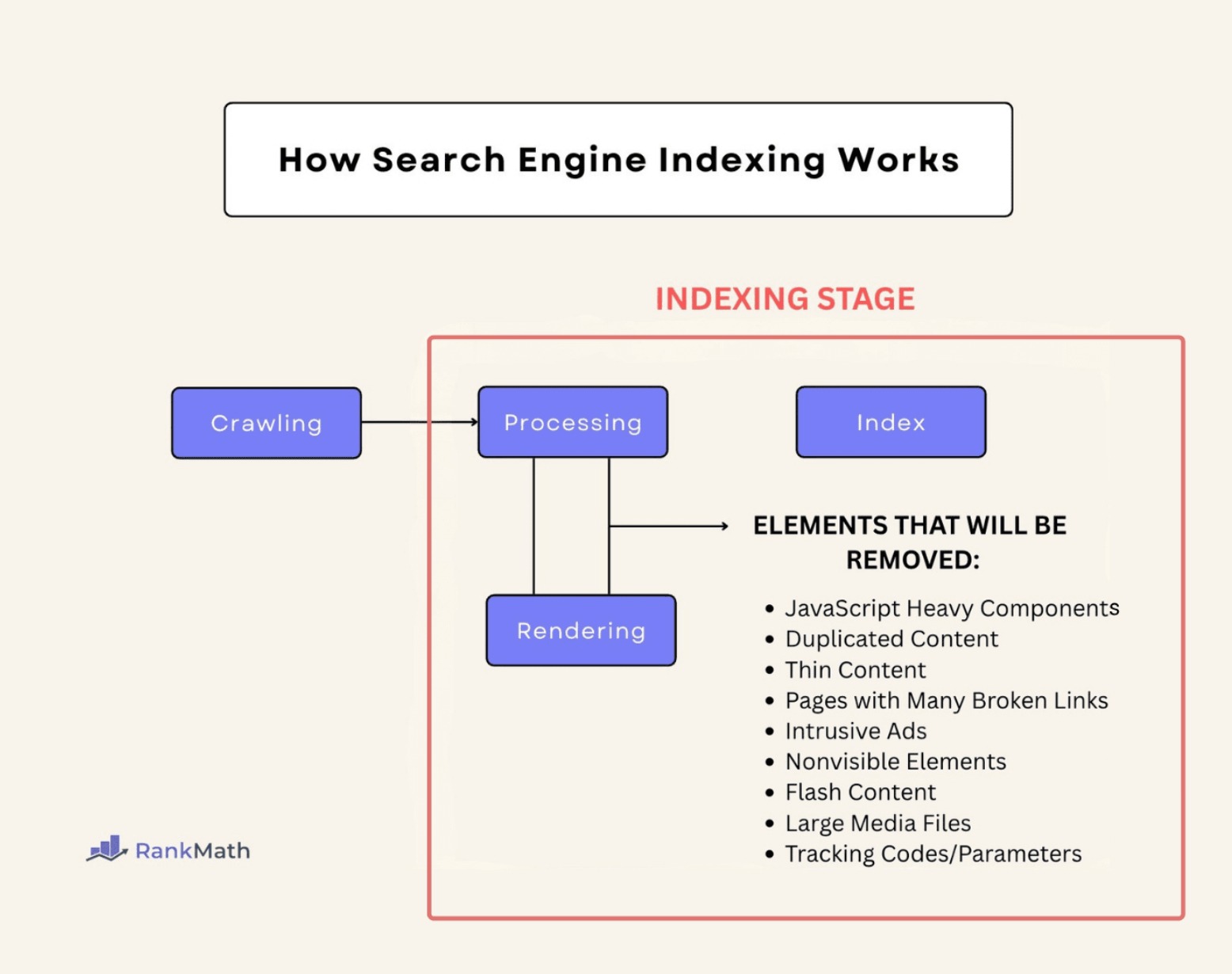
An index does not update itself; it is the final destination in a continuous, automated data pipeline managed by web scrapers, parsers, and distributed storage clusters. Understanding this lifecycle is critical for anyone managing web assets or building custom search applications.
- [ Web URL Discovery ]
- [ Crawling ] — Fetches raw HTML via HTTP requests
- [ Parsing ] — Extracts text, links, and metadata
- [ Indexing ] — Tokenizes and writes to the Inverted Index
1. Discovery and Crawling
The process begins with discovery, where automated bots (often called spiders or crawlers) traverse the web by following hyperlinks from known pages to new ones. Search engines maintain massive URL queues, prioritizing pages based on update frequency, historical importance, and site structure. The crawler issues HTTP GET requests to fetch the raw HTML, CSS, JavaScript, and asset files associated with each target URL.
2. Parsing and Rendering
Once the raw document is retrieved, the parsing engine analyzes the markup. Historically, this was a straightforward extraction of text nodes from static HTML. However, modern web pages rely heavily on client-side rendering frameworks like React, Angular, or Vue. As a result, search engines must run headless browsers to execute JavaScript, evaluate the Document Object Model (DOM), and capture the fully rendered page content before it can be accurately processed.
3. Writing to the Index
After rendering and text extraction, the document is sent to the indexing phase. Here, the text is tokenized, matched against existing vocabulary dictionaries, and added to the inverted index across distributed database shards. If a page has been updated, the engine performs a delta update—modifying existing postings lists rather than rewriting the entire database—ensuring that fresh content goes live with minimal delay.
Comparing Search Index Types and Implementations
Different search environments require distinct indexing architectures. Selecting the right indexing strategy depends heavily on data volume, query complexity, and update frequency.
| Index Architecture | Primary Use Case | Strengths | Limitations |
|---|---|---|---|
| Inverted Index | Full-text search engines (Elasticsearch, Solr) | Lightning-fast keyword matching, phrase queries, scalability | High memory usage for postings lists, complex dynamic updates |
| B-Tree Index | Relational databases (PostgreSQL, MySQL) | Exact matches, range queries (>), efficient sorting |
Inefficient for unstructured natural language full-text search |
| Vector Index | Semantic search, AI embeddings (Pinecone, Milvus) | Captures contextual meaning, handles synonyms and conceptual queries | Computationally heavy, requires hardware acceleration (GPUs/TPUs) |
| Bitmap Index | Data warehouses, low-cardinality attributes | Extremely compact for columns with few unique values | Poor performance on high-cardinality data with frequent writes |
Common Challenges and Troubleshooting in Search Indexing
Even with advanced automation, maintaining a healthy search index can present significant operational and technical hurdles. Whether managing enterprise web visibility or administering an internal search cluster, administrators frequently encounter performance bottlenecks and visibility gaps.
Index Bloat and Storage Costs
As websites grow, indices accumulate obsolete URLs, parameter-driven duplicate pages, and low-value utility files (such as tag archives, print views, or session-id URLs). This phenomenon, known as index bloat, wastes crawl budget and consumes excessive memory and storage.
- Resolution: Implement robust canonicalization (
rel="canonical"), utilize proper robots.txt directives, and apply strict URL parameter handling to prevent search engines from indexing duplicate or low-value paths.
Rendering Delays and JavaScript Overhead
When search engines struggle to execute client-side JavaScript efficiently, content may remain unindexed, leading to dropped visibility.
- Resolution: Adopt Server-Side Rendering (SSR) or Static Site Generation (SSG) for critical content, ensuring that core text and metadata are present in the initial server response HTML payload.
Concurrency and Real-Time Update Lags
In high-throughput enterprise applications, ensuring that database updates are reflected instantly in the search index can cause CPU spikes and write bottlenecks.
- Resolution: Implement asynchronous queuing mechanisms (such as Apache Kafka or RabbitMQ) to batch document changes, balancing freshness requirements with cluster stability.
Frequently Asked Questions
What is the difference between crawling and indexing?
Crawling is the discovery and retrieval phase where a bot downloads a web page's raw code and assets. Indexing is the subsequent processing phase where the retrieved content is analyzed, tokenized, and organized into a searchable database structure. A page can be crawled without being indexed if the search engine determines it is low-quality or duplicate.
Why do some web pages fail to appear in a search index?
Pages often fail to index due to technical blocks (such as noindex meta tags or restrictive robots.txt rules), poor content quality, lack of internal links pointing to the URL (orphan pages), or crawl budget limitations. Resolving these issues requires checking server logs and using search console validation tools.
How do vector indices differ from traditional inverted indices?
Traditional inverted indices rely on exact or normalized keyword matching. Vector indices, by contrast, map documents and queries into high-dimensional mathematical spaces using machine learning embeddings. This allows the search engine to retrieve results based on semantic meaning and conceptual similarity rather than strict word overlap.
Can I force a search engine to update its index immediately?
While you cannot manually force an instant global update, major search engines provide tools—such as URL inspection submission forms or Indexing APIs—to request expedited recrawling and re-indexing for updated or newly published URLs.
What causes index fragmentation in database systems?
Index fragmentation occurs over time as records are inserted, updated, and deleted, causing physical data pages to become disorganized and non-sequential. This degrades query performance because the storage engine must perform additional disk I/O operations to read scattered blocks. Routine maintenance, such as index rebuilding or defragmentation, resolves this issue.
Next Actions for Implementation
To optimize your interaction with search indices—whether you are optimizing a website for public search engines or architecting an internal enterprise search system—begin by auditing your current data flow. Verify that your core content is accessible without requiring complex JavaScript execution, ensure your metadata and canonical tags are cleanly structured, and monitor indexing coverage reports regularly to catch crawl errors before they impact overall system performance.