The term FHEA stands for Fellow of the Higher Education Academy, a professional recognition awarded to individuals who demonstrate a sustained commitment to teaching and learning within the higher education sector. It is administered by Advance HE, a member-led charity that works with institutions to improve higher education outcomes through professional development, teaching excellence, and leadership initiatives.
The Role of Advance HE and the Professional Standards Framework
To understand the FHEA designation, one must first understand the landscape of professional standards in university teaching. Advance HE serves as the primary body in the United Kingdom and internationally that manages the Professional Standards Framework (PSF). The PSF is a globally recognized set of principles designed to support the development of teaching and learning practice in higher education.
The FHEA represents the second of four levels of fellowship offered by Advance HE:
- Associate Fellow (AFHEA): For those with less extensive experience or those in supportive roles.
- Fellow (FHEA): For those who can demonstrate a broad understanding of effective teaching and learning support.
- Senior Fellow (SFHEA): For those who demonstrate a sustained record of effectiveness and impact.
- Principal Fellow (PFHEA): For those who demonstrate a sustained record of strategic impact on teaching and learning at an institutional or global level.
The FHEA status is not an academic qualification in the traditional sense, like a Master's degree or PhD. Instead, it is a professional recognition of practice. It validates that the holder has met the requirements of the PSF at the appropriate level of complexity and impact.
Requirements and Eligibility for FHEA
Achieving FHEA status requires a candidate to demonstrate that their practice is aligned with the dimensions of the PSF. These dimensions consist of three categories:
- Areas of Activity: The tasks performed by staff, such as designing learning activities, supporting learners, and engaging in assessment and feedback.
- Core Knowledge: The intellectual foundations of teaching, such as knowledge of subject material, methods for teaching and learning in the discipline, and an understanding of how students learn.
- Professional Values: The ethical and social responsibilities inherent in the role, including respecting diversity, promoting inclusivity, and evidencing a commitment to continuous professional development.
To apply, candidates must submit an application—often referred to as a "Fellowship Application"—that includes a written account of their professional practice. This account must be supported by references from colleagues who can verify the impact and effectiveness of the applicant’s work.
The Application Process: A Step-by-Step Approach
Applying for FHEA is a rigorous reflective process. Candidates must look back at their career and teaching philosophy, mapping their experiences to the PSF descriptors.
- Self-Assessment: Candidates should review the PSF guidance documents provided by Advance HE. This step ensures that the individual truly operates at the "Fellow" level rather than the Associate or Senior level.
- Institutional vs. Direct Route: Many universities in the UK and internationally have an internal "accredited scheme." These institutions are authorized by Advance HE to award fellowship status internally. If a candidate’s institution is accredited, they should follow the internal application route. If not, the candidate must apply directly to Advance HE.
- Reflective Narrative: The core of the application is a written statement. It is not merely a CV; it is a critical reflection on why the candidate teaches in a certain way, how they use student feedback to iterate on their methods, and how they contribute to the broader learning environment.
- Verification: The application must be accompanied by peer references. These referees must be able to confirm that the candidate’s claims regarding their teaching impact are accurate and supported by evidence.
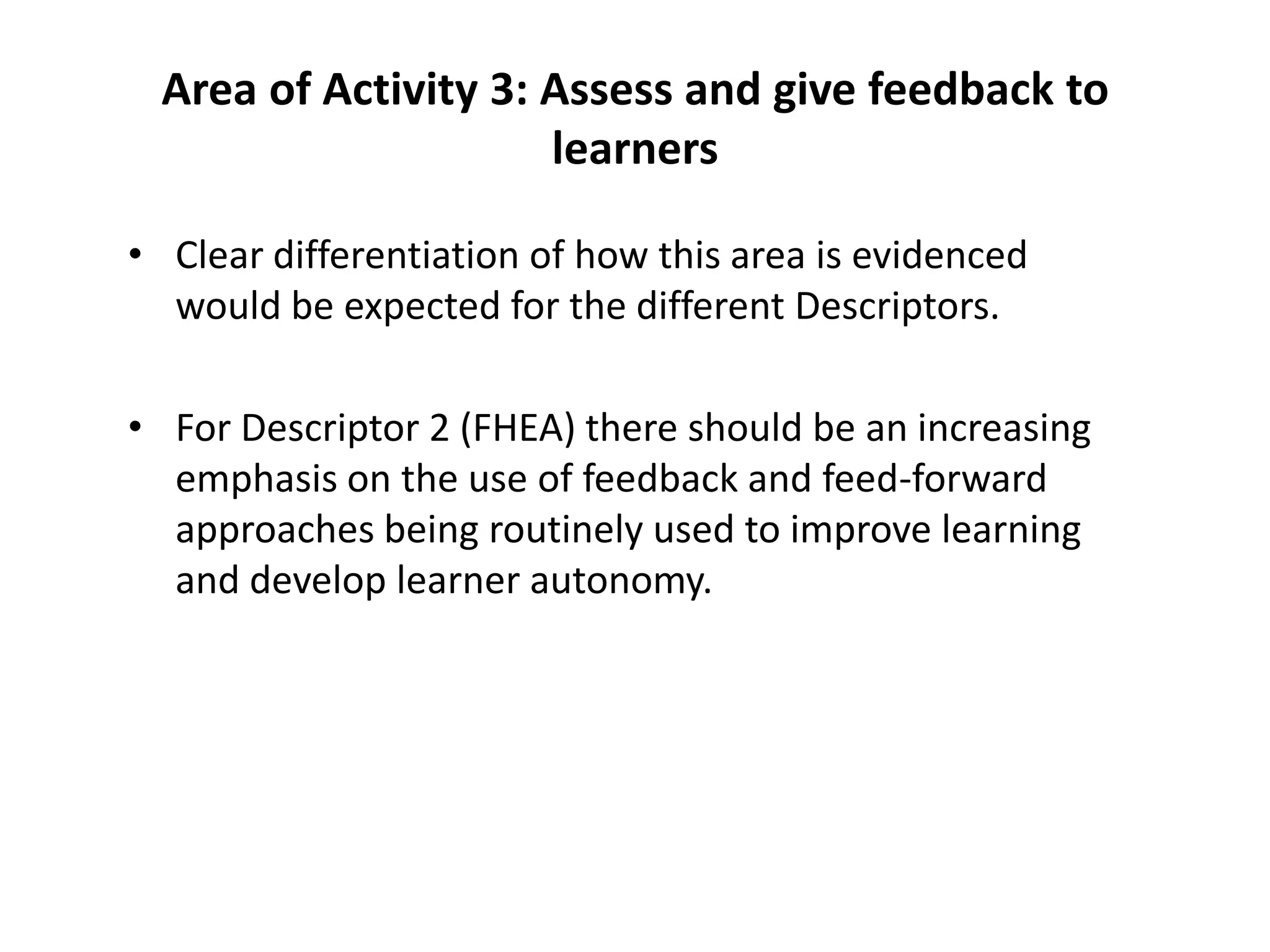
- Assessment: The application is assessed by a panel of experienced practitioners who determine if the evidence provided meets the Descriptor 2 (D2) criteria, which corresponds to the Fellowship level.
Comparative Overview of Fellowship Levels
The distinctions between the levels of fellowship are determined by the depth, breadth, and sustained nature of the applicant's impact.
| Fellowship Level | Target Audience | Primary Focus |
|---|---|---|
| AFHEA | Early-career, graduate teaching assistants, professional staff. | Engagement with specific aspects of the PSF. |
| FHEA | Established lecturers, tutors, and academic staff. | Demonstrated effectiveness across a broad range of practice. |
| SFHEA | Experienced academics, program leads, module leaders. | Sustained record of impact and influence on others. |
| PFHEA | Senior leaders, directors of learning and teaching. | Institutional-level strategic influence and impact. |
Why FHEA Matters in 2026
In the competitive landscape of 2026, FHEA status serves as an internationally recognized benchmark of quality. For individual academics, it acts as a portable credential. Should an educator decide to move institutions or cross borders, the FHEA designation provides objective evidence of their commitment to professional development.
For institutions, the number of staff members holding FHEA status is often used as a metric for teaching quality in internal audits and external reviews. Many universities now mandate or strongly encourage FHEA attainment within the first few years of a full-time academic appointment. It serves as a signaling mechanism that the university prioritizes high-quality pedagogy alongside high-quality research.
Common Misconceptions
There are several persistent myths regarding FHEA:
- "It is a research degree": This is incorrect. FHEA is focused exclusively on the teaching aspect of an academic's role. While research-informed teaching is encouraged, the fellowship is not a measure of one's research output or grant success.
- "It is for life": Once awarded, FHEA status remains for as long as the recipient maintains their engagement with the principles of the PSF. Most institutions expect fellows to continue their professional development, though there is no formal "re-certification" required by Advance HE itself.
- "Only university lecturers can apply": While common in higher education, eligibility extends to anyone who teaches or supports learning in a higher education context, including librarians, learning technologists, and academic developers.
Addressing Unresolved Challenges
Despite its prestige, the FHEA process is not without its challenges. The most significant is the "burden of evidence." Candidates often struggle to balance the time-intensive process of writing a reflective narrative with their existing teaching, administrative, and research loads.
Furthermore, because the application is fundamentally a piece of reflective writing, it can be subjective. Applicants are encouraged to consult with their institutional "Fellowship mentors"—senior staff members who have already achieved fellowship—to ensure that their language aligns with the requirements of the Advance HE panels.
Frequently Asked Questions
Is FHEA an academic degree like a PhD? No. FHEA is a professional status, not an academic degree. It does not replace postgraduate qualifications, nor does it provide a formal title such as "Doctor." It is a badge of recognition for pedagogical proficiency.
Can I list FHEA after my name? Yes. Once awarded, you are entitled to use the post-nominal letters FHEA after your name, for example: "Dr. Jane Doe, FHEA." This is a recognized professional convention in the sector.
How long does an application take to prepare? The timeline varies significantly depending on the candidate's existing experience and the support provided by their institution. On average, a motivated candidate may spend three to six months gathering evidence and drafting the reflective account.
What happens if my application is unsuccessful? If a direct application to Advance HE is unsuccessful, the candidate usually receives constructive feedback from the assessment panel. They can then choose to address the missing components and resubmit the application, often within a set timeframe.
Do I have to pay to maintain my status? If you apply directly to Advance HE, there is an application fee. Some institutions cover this cost for their staff. Once the fellowship is awarded, there are no annual subscription fees to maintain the title, though you are encouraged to remain active within the higher education community.
Next Actions for Prospective Applicants
If you are currently teaching in a higher education environment and considering applying for FHEA, your first step should be to investigate your own institution’s status. Visit your university’s internal staff development or "learning and teaching" portal to see if they hold an accreditation agreement with Advance HE.
If they do, reach out to the internal fellowship mentor or the program lead for the accredited scheme. They will be able to provide you with a roadmap of upcoming workshops and submission deadlines specific to your institution. If your institution does not have a scheme, you should navigate directly to the Advance HE website to review the current application handbooks and the specific criteria for the Fellowship (D2) category.