The Five Points Gang was a dominant criminal organization based in Lower Manhattan during the late 19th and early 20th centuries. Led by Paul Kelly, it served as a foundational "university" for notorious mobsters like Al Capone and Johnny Torrio, transitioning street-level thuggery into the structured hierarchy of modern American organized crime.
The Geography of Infamy: Understanding the Five Points District
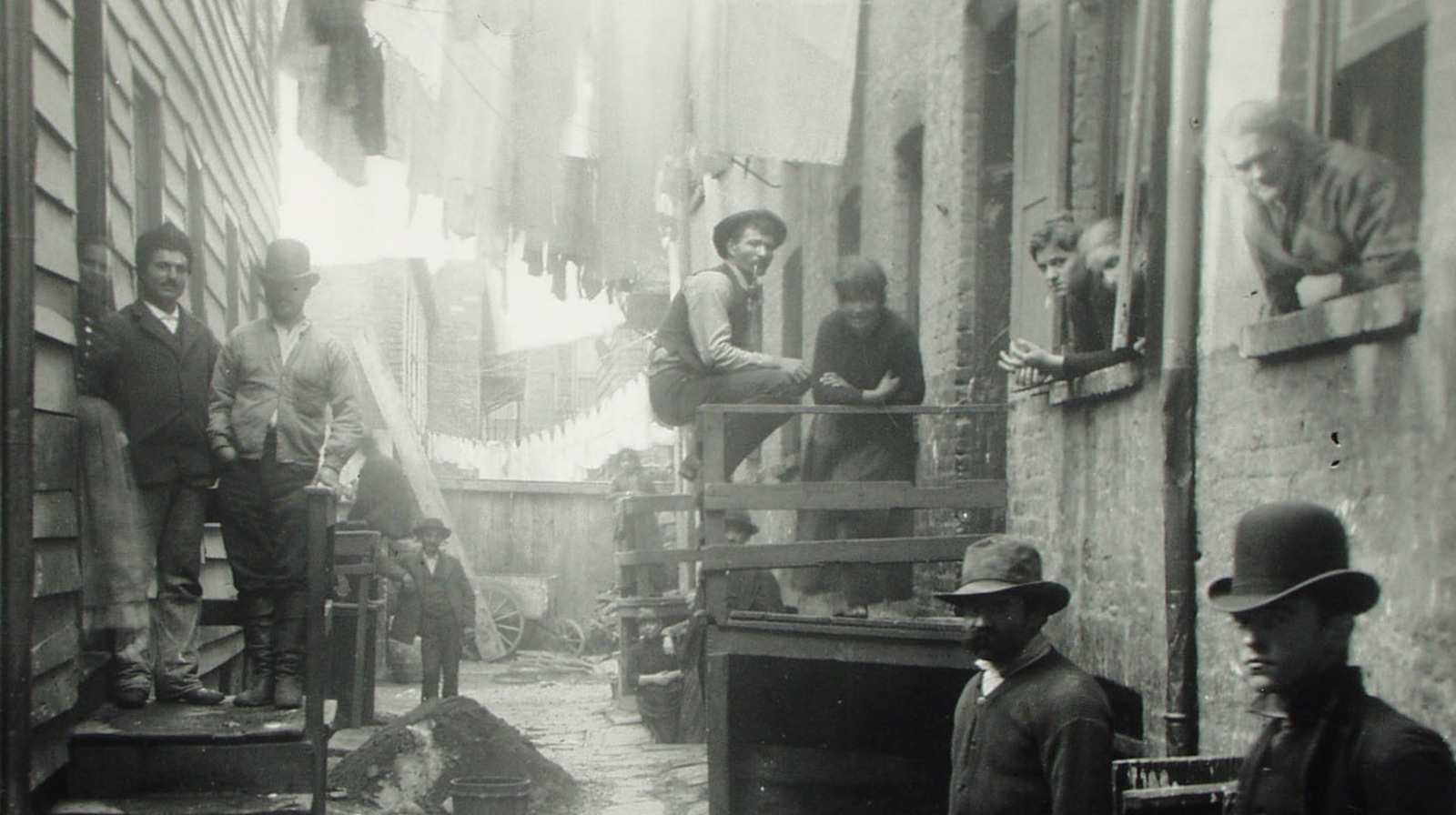
To understand the Five Points Gang, one must first understand the environment that birthed it. By the mid-1800s, the Five Points neighborhood in Lower Manhattan—named for the five-way intersection of Worth (formerly Anthony), Baxter (formerly Orange), and Park (formerly Cross) Streets—was internationally renowned as the most dangerous slum in the world. As we look back from 2026, the area is now home to the serene Columbus Park and various New York City civic buildings, but in the late 1800s, it was a claustrophobic maze of tenements, brothels, and "dens of vice."
The neighborhood was characterized by extreme poverty, high infant mortality, and a volatile mix of immigrant populations, primarily Irish and Italian. The geographical constraints of the area created a pressure cooker where physical strength was the only reliable currency. The infamous Old Brewery, a massive tenement building that allegedly housed over 1,000 people at its peak, became a symbol of the squalor and lawlessness that defined the district. It was within this specific socio-economic crucible that the Five Points Gang emerged, not merely as a group of criminals, but as a survival mechanism for a marginalized population.
Paul Kelly and the Professionalization of Crime
While earlier gangs like the Dead Rabbits and the Bowery Boys were largely unorganized brawlers, the Five Points Gang achieved a different level of sophistication under the leadership of Paul Kelly (born Paolo Antonio Vaccarelli). Kelly was a former prize-fighter who realized that the future of crime lay in organization, political alliances, and diversified "business" interests rather than raw street fighting.
Kelly was an anomaly among the gang leaders of his time. He was cultured, spoke several languages, and maintained a polished appearance. He used the proceeds from his criminal enterprises to open legitimate-looking athletic clubs and dance halls, most notably the New Brighton Athletic Club. This establishment served as the headquarters for the gang and a training ground for its members.
Under Kelly’s direction, the Five Points Gang expanded its operations beyond simple robbery and extortion. They moved into:
- Labor Racketeering: Controlling the docks and garment district unions through intimidation.
- Political Enforcement: Working as the "muscle" for Tammany Hall, ensuring that voters chose the "right" candidates through intimidation and "repeat voting" (a practice known as "repeating" where a person votes multiple times in different districts).
- Gambling and Prostitution: Centralizing the management of underground casinos and brothels to ensure steady revenue and minimize police interference through systematic bribery.
The "University of Crime": Nurturing Future Legends
The Five Points Gang is most significant in historical retrospection because of its role as a talent incubator. It was here that the transition from the chaotic gangs of the 19th century to the "National Crime Syndicate" of the 20th century began. Many of the most powerful names in Mafia history started their careers running errands or acting as enforcers for Paul Kelly.
Johnny Torrio: The Master Strategist
Johnny Torrio, often called "The Fox," learned the value of diplomacy and business-like efficiency from Kelly. Torrio eventually moved to Chicago, where he laid the groundwork for what would become the Chicago Outfit. His preference for negotiation over gunfire was a direct lesson learned from Kelly’s sophisticated management style in Manhattan.
Al Capone: The Enforcer
A young Al Capone joined the Five Points Gang while living in New York. It was while working as a bouncer at the Harvard Inn (a Five Points-affiliated establishment) that Capone received his famous facial scars during a dispute with a patron. Under the tutelage of Torrio and Kelly, Capone learned how to scale criminal operations, a skill set he would later use to dominate the illegal liquor trade during Prohibition.
Lucky Luciano and Meyer Lansky
While they were slightly younger, figures like Charles "Lucky" Luciano and Meyer Lansky were influenced by the power vacuum left by the Five Points Gang. They took the organizational lessons of Paul Kelly to their logical conclusion, eventually abolishing the "Boss of Bosses" model in favor of a corporate-style board of directors known as The Commission.
The Great Rivalry: Five Points vs. The Monk Eastman Gang
One of the most violent periods in New York history was the conflict between the Italian-dominated Five Points Gang and the Jewish Monk Eastman Gang. This was not just a battle over ethnic territory; it was a battle for the favor of Tammany Hall politicians.
The rivalry reached a fever pitch in 1903 during the Battle of Rivington Street. For hours, hundreds of gang members engaged in a full-scale shootout in the middle of the city. The police were largely powerless to stop it, and the public outcry was so significant that Tammany Hall was forced to intervene.
In a bizarre historical footnote, the politicians arranged for a boxing match between Paul Kelly and Monk Eastman to settle the dispute once and for all. The match lasted for hours and ended in a draw, proving that neither gang could easily displace the other. Eventually, the law caught up with Eastman, and Kelly’s power was diluted by internal fractures and a changing political landscape, but the conflict defined the era’s perception of urban lawlessness.
Comparison of Early 20th Century New York Gangs
The following table compares the dominant organizations of the era to highlight the specific strengths and characteristics of the Five Points Gang.
| Feature | Five Points Gang | Monk Eastman Gang | The Whyos |
|---|---|---|---|
| Primary Ethnicity | Italian-American | Jewish-American | Irish-American |
| Key Leader | Paul Kelly | Monk Eastman | Danny Lyons / Red Rocks Farrell |
| Primary Territory | Lower Manhattan (Five Points) | Lower East Side | The Bowery / West Side |
| Core Strategy | Organizational Discipline | Numbers and Raw Violence | Guerilla Tactics / Hired Murder |
| Political Tie | Deeply connected to Tammany Hall | Secondary Tammany muscle | Limited / Opportunistic |
| Legacy | Birth of the National Syndicate | Faded after Eastman's imprisonment | Predated modern "organized" crime |
The Role of Tammany Hall and Political Corruption
The Five Points Gang could not have existed in its dominant form without the complicity of the New York political machine known as Tammany Hall. This relationship was a precursor to the systemic corruption seen during the 1920s.
Tammany Hall politicians needed two things to stay in power: votes and silence. The Five Points Gang provided both. On election days, gang members would travel from precinct to precinct, changing clothes or shaving their facial hair to vote multiple times. They would also physically intimidate opposition voters and poll watchers. In exchange, the gang received "protection." When a Five Pointer was arrested, a call from a local ward boss or "district leader" was often enough to have the charges dropped or the evidence "lost."
This symbiotic relationship eventually crumbled as the city's middle class grew and reform movements gained traction. The 1894 Lexow Committee investigation had already begun to expose the depths of police corruption, and as the 20th century progressed, the blatant violence of gangs like the Five Pointers became a political liability rather than an asset.
The Decline of the Gang and the Evolution of the Mafia
By the mid-1910s, the Five Points Gang began to dissolve as a singular entity. Several factors contributed to this:
- Internal Fractures: Rivals within the Italian criminal underworld began to challenge Kelly’s authority, leading to assassination attempts and splinter groups.
- The Rise of the Camorra and Mafia: More traditional Sicilian and Neapolitan groups began to organize based on lineage and old-world "honor codes," which differed from Kelly's multi-ethnic, business-first approach.
- Physical Redevelopment: The city began clearing the slums of Five Points. The "Old Brewery" had been demolished much earlier, and the construction of the New York County Courthouse and other civic structures physically erased the gang's home turf.
- Prohibition: The onset of the 18th Amendment in 1920 changed the scale of criminal enterprise. The Five Points Gang’s street-level rackets were eclipsed by the massive profits of bootlegging, which required international logistics and larger-scale syndication.
Paul Kelly himself eventually transitioned into the labor movement, ironically becoming a vice president for the International Longshoremen's Association. He died in 1936, having survived the era of street gangs to see his former pupils like Al Capone become the most famous men in America.
Frequently Asked Questions
Did the Five Points Gang actually exist, or is it a fictional creation of movies?
The Five Points Gang was a very real criminal organization that operated from roughly the 1890s to the 1910s. While movies like Gangs of New York (directed by Martin Scorsese) dramatize the history and combine elements of several different eras (moving events from the 1860s to look more like the 1900s), the fundamental existence of the gang and its leaders like Paul Kelly is documented in historical records, police archives, and contemporary newspaper reports from the New York Times and New York Sun.
Who was the most powerful member of the Five Points Gang?
Paul Kelly (Paolo Antonio Vaccarelli) was the most powerful leader in terms of organizational control. However, in terms of long-term historical impact and notoriety, his protege Al Capone became the most famous "alumnus." Johnny Torrio was perhaps the most influential in terms of actual criminal strategy, as he bridged the gap between the street gangs and the modern Mafia.
Where was the Five Points neighborhood located in modern New York?
The heart of the Five Points was located at what is now the intersection of Worth Street, Baxter Street, and Park Street in Lower Manhattan. Today, the area is largely covered by the New York Supreme Court building, the United States Courthouse, and Columbus Park. It is situated between the modern neighborhoods of Chinatown, the Civic Center, and Tribeca.
How did the gang get its name?
The gang took its name directly from the neighborhood where it was based. The "Five Points" referred to the five-way intersection created by the meeting of Anthony (Worth), Cross (Park), and Orange (Baxter) streets. At the time, this intersection was the focal point of the city's densest and most impoverished residential area.
Was the Five Points Gang strictly Italian?
While the leadership and core membership under Paul Kelly were predominantly Italian-American, the gang was known for its willingness to work with other ethnicities, which was a strategic move by Kelly. This was a departure from earlier gangs which were strictly Irish and later Mafia "families" which were strictly Sicilian or Southern Italian.
Final Recommendations for Researchers
For those looking to explore the history of the Five Points Gang in 2026, the following steps are recommended:
- Visit the New York City Municipal Archives: This repository contains the most accurate records of police blotters and court cases involving Paul Kelly and his associates.
- Explore the Tenement Museum: While located slightly north of the original Five Points, the Tenement Museum provides the best physical context for the living conditions that necessitated the rise of such gangs.
- Consult Primary Sources: Research the Lexow Committee reports and the works of Jacob Riis, specifically How the Other Half Lives, which provides a contemporary (if biased) view of the neighborhood during the gang's peak.
The history of the Five Points Gang is not merely a tale of crime; it is a story of urban development, immigrant struggle, and the birth of a sophisticated criminal infrastructure that would influence American law enforcement and politics for over a century.